

Most online sellers stock products they like. They choose items they personally find interesting, they post what feels good, and they hope their audience agrees.
Sometimes it works. More often, it results in slow-moving inventory, disappointing sales on products you were sure would fly, and a nagging feeling that you’re guessing more than you’re planning.
The sellers who consistently stock the right products, write listings that convert, and know which collections to push before a trend peaks are not luckier than you. They are better informed. And increasingly, that information advantage comes from one place: artificial intelligence.
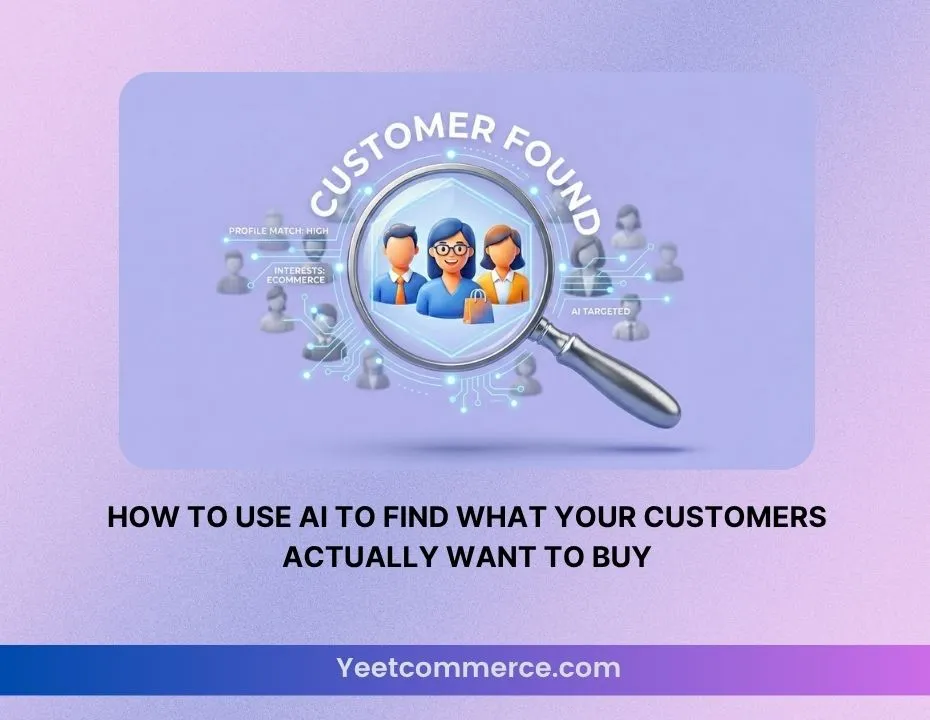
This guide is a practical walkthrough of how small e-commerce sellers — with no data science background, no marketing agency, and no large budget — can use AI tools to understand their customers more clearly than most big brands understand theirs.
We are not talking about sci-fi. We are talking about tools you can use this week, applied to decisions you are already making.
| What you will learn: Why gut instinct fails and where AI fills the gap The 6 data sources your customers are already giving you — for free Step-by-step: how to use AI to analyse each source How to translate AI insights into actual product and content decisions Real prompt templates you can use with any AI tool today How YeetCommerce’s built-in AI makes this even faster |
Part 1: Why Gut Instinct Alone Is Not Enough
Gut instinct is not worthless. It is built from experience, pattern recognition, and real knowledge of your customers. Many successful products were launched because a founder had a strong feeling that the market was ready.
But gut instinct has a systematic weakness: it is backwards-looking. It tells you what worked before. It struggles with what is emerging now. And it is highly susceptible to the products you personally find appealing — which may not map cleanly onto what your customers actually want.
Here is the problem in concrete terms. A clothing seller adds three new styles: one she personally loves, one she thinks will be safe, and one she chose based on what her Instagram comments and search data suggested. In most cases, the data-led choice outperforms the gut-led choices. Not because data is magic, but because data is simply the aggregated preferences of real people who are already in your market.
The data your customers are already giving you
Your customers are constantly telling you what they want. They are telling you in:
- The search terms they type into Google before they find you
- The questions they ask in your DMs and comments
- The products they click on but do not buy
- The reviews they leave — yours and your competitors’
- The hashtags and content they engage with on social media
- The products they return and the reasons they give
The problem is not that this data does not exist. The problem is that without AI, it takes enormous time and effort to collect, organise, and interpret it. Most small sellers simply do not have that time — so the data goes unused.
AI changes that equation entirely. Tasks that used to require a dedicated analyst working for weeks can now be done in an afternoon with the right prompts and the right tools.
Part 2: The 6 Data Sources Your Customers Are Already Giving You
Before you can use AI to analyse customer intent, you need to know where to look. Here are the six richest sources of customer insight available to any online seller — most of which are free.
Source 1: Search queries and autocomplete data
Google’s autocomplete and ‘People also ask’ features are not just SEO tools. They are a real-time window into what your potential customers are thinking and searching for right now. When someone types “women’s linen” into Google and sees autocomplete suggestions like “women’s linen trousers wide leg,” “women’s linen shirt oversized,” and “women’s linen co-ord set” — that is direct evidence of demand. It is not an opinion or a prediction. It is what thousands of real people are actively looking for.
Source 2: Competitor reviews
Your competitors’ customer reviews are one of the most underused sources of product intelligence available to any seller. When a customer writes a review, they are telling you exactly what they valued, what they wished was different, and what problem the product solved for them. Reading 50 reviews on your top competitor’s best-selling product will teach you more about your market than most paid research reports.
Source 3: Your own DMs and customer messages
The questions your customers ask before and after purchase are a goldmine of product development and content ideas. “Does this come in a smaller size?” tells you about a gap in your sizing. “How long does shipping take to Karachi?” tells you about a logistics concern affecting purchase decisions. “Can I use this for outdoor events?” tells you about a use case you may not be marketing to. Every message is a signal.
Source 4: Social media comments and hashtag content
Comments on your posts and your competitors’ posts reveal what resonates emotionally with your audience. Hashtag communities around your product category show you the language your customers use, the problems they complain about, the aesthetics they are drawn to, and the trends that are building momentum before they peak.
Source 5: Your own sales and browse data
Which products get clicked but not bought? Which ones convert at a higher-than-average rate? Which ones have been in your catalogue for three months with near-zero sales? Your store’s own analytics tell a story about demand — if you know how to read it.
Source 6: Forums, groups, and communities
Facebook groups, Reddit communities, WhatsApp seller networks, and niche online communities related to your product category are where your customers talk to each other without the filter of speaking to a brand. This is where unfiltered demand lives. What they complain about, what they recommend to each other, what they say they wish existed — that is primary research, available for free.
Part 3: How to Use AI to Analyse Each Source — Step by Step
Now we get to the practical part. Here is exactly how to use AI tools to extract insights from each of the six sources above. You do not need any technical skills. You need an AI tool (any major one works), the data, and the right prompts.
| Step 1: Analyse search intent with AI What to do: Go to Google and type the main keyword for your product category. Note the autocomplete suggestions, the ‘People also ask’ questions, and the related searches at the bottom of the page. Do the same on platforms like YouTube and TikTok if relevant. Then bring this data to an AI tool and use a prompt like this: “I sell [product category] online. Here are the top Google autocomplete suggestions and ‘People also ask’ questions for my category: [paste list]. Analyse these and tell me: what are the top unmet needs or desires my customers have? What product features or variations are most in demand? What concerns or objections do buyers have? What content topics should I create to attract these buyers?” What you get: A structured analysis of what your market is actively seeking, organised by theme. This can directly inform your next product order and your next three months of content. |
| Step 2: Mine competitor reviews for product gaps What to do: Go to your top competitor’s store, marketplace listing, or Google reviews. Copy 20–50 customer reviews — a mix of high-rated and low-rated ones. Paste them into an AI tool with this prompt: “These are customer reviews for a [product type] sold by one of my competitors. Please analyse them and identify: the top 5 things customers love most about this product, the top 5 complaints or disappointments, any features or improvements customers specifically mention wanting, language patterns that reveal how customers describe this product and its benefits, and any demographic signals about who is buying this product.” What you get: A clear map of where your competitor is winning and where they are falling short. Every gap they have is an opportunity for you. Every strength they have tells you what your customers already value and expect. |
| Step 3: Extract insight from your customer messages What to do: Collect a batch of your customer DMs, emails, or WhatsApp messages — especially pre-purchase questions and post-purchase feedback. Remove any personal details, then paste them into an AI tool. Use this prompt: “These are messages from customers who have either asked questions before buying or given feedback after buying from my online store. Please identify: the most common questions asked before purchase (and what they reveal about buying hesitations), recurring themes in what customers valued after receiving their order, any product gaps or sizing or colour requests that appear more than once, and the specific language customers use to describe what they want.” What you get: A customer voice analysis. The language patterns alone are invaluable — the exact words your customers use to describe what they want are the exact words you should use in your product listings, your ads, and your social content. |
| Step 4: Decode social media signals What to do: Spend 20 minutes in the comments section of 5–10 posts from accounts in your product niche — yours and your competitors’. Copy the comments that feel most revealing: expressions of desire, complaints, questions, comparisons. Also note which posts got the most engagement. Use this prompt: “These are comments from social media posts about [product category]. Analyse them and tell me: what emotions or desires are most commonly expressed? What are customers comparing this product category against? What language do they use to describe what they want vs. what they have found? What content formats or topics seem to generate the most engagement? Are there any emerging trends or requests that appear multiple times?” What you get: An emotional map of your market. You learn not just what people want to buy but how they feel about the category — which is exactly the intelligence you need to write captions, ads, and product descriptions that actually connect. |
| Step 5: Interpret your own store analytics What to do: Look at your store’s analytics and note: your top 5 most-viewed products, your top 5 best-converting products, any products with high views but low conversions, any products with near-zero traffic, and your best-performing search terms if available. Use this prompt: “Here is data from my online store’s analytics: [paste your data]. Please analyse this and tell me: which products have a conversion problem versus a traffic problem, what the high-view/low-conversion products suggest about customer expectations not being met, what the best-converting products have in common, and what product or content opportunities this data points to.” What you get: A clear diagnosis of where your store is working and where it is leaking. High views with low conversions almost always mean a listing problem — your AI analysis will help you identify which element is failing (price, photos, description, or sizing information). |
| Step 6: Research communities and forums What to do: Find 2–3 online communities where your target customers gather. This might be a Facebook group for a hobby related to your products, a Reddit community, a WhatsApp group for local sellers, or even a comment section on a YouTube channel in your niche. Spend 30 minutes reading posts and note the recurring themes, questions, and frustrations. Use this prompt: “These are posts and comments from an online community of people interested in [topic related to your product]. Analyse these and identify: the top 5 problems or frustrations this community experiences, the products or solutions they are currently using and what they like or dislike about them, any gaps in the market they mention explicitly or implicitly, the language and terminology they use to describe their needs, and any seasonal or situational patterns in what they discuss.” What you get: Unfiltered market research. Community conversations are where people are most honest about what they actually want — because they are talking to peers, not a brand. |
Part 4: Turning AI Insights Into Real Decisions
Insights without action are just interesting reading. Here is how to translate what you learn into concrete decisions for your store.
Product decisions
Use your AI analysis to answer these questions before your next stock order:
- Which product variations (sizes, colours, materials) are most in demand based on what search data and review analysis showed?
- Are there product gaps in the market — things multiple customers mentioned wanting that nobody in your competitive set currently offers well?
- Which of your current products have a positioning problem rather than a demand problem? (High views, low conversions often mean the listing is failing, not the product.)
- Which slow-moving products should be discounted and cleared, and which ones need a listing overhaul before being written off?
Listing and content decisions
The language AI surfaces from your customer analysis is directly usable in your product listings and content:
- Use the exact phrases your customers use when they describe what they want — in your product titles, bullet points, and descriptions.
- Answer the pre-purchase questions you identified directly in your product descriptions. Every question your customers ask before buying is an objection that your listing should be resolving.
- The emotional language from social media comments should inform your Instagram captions, your ad copy, and your email subject lines.
Content calendar decisions
The questions that come up repeatedly in search data, DMs, and community forums are your content calendar. Each one is a blog post, a Reel, or a Stories series:
- “Does this fabric breathe well in summer?” becomes a Reel showing the fabric in outdoor settings with a summer styling guide.
- “What is your return policy like?” becomes a Story series walking through your process.
- “Can I use this for gifting?” becomes a gift guide collection on your website.
Inventory planning decisions
Seasonal patterns from community research and search volume trends can inform when to increase stock. If your AI analysis of community forums consistently shows increased discussion about a specific product use case in the months before a season or holiday, that is your signal to have inventory ready before the wave, not during it.
Part 5: AI Prompt Templates to Save and Reuse
Here are six ready-to-use prompt templates for ongoing customer research. Save these and run them monthly as a regular part of your business review.
| Research task | Frequency | What it drives |
| Monthly search trend analysis | Once a month | Identifies emerging demand before it peaks. Use to plan stock 4–6 weeks ahead. |
| Competitor review sweep | Quarterly | Maps market gaps and competitor weaknesses. Use before major product decisions. |
| Customer message analysis | Monthly | Surfaces recurring questions and language patterns. Use to improve listings continuously. |
| Social comment mining | Bi-weekly | Tracks emotional trends and engagement signals. Use for content planning. |
| Store analytics interpretation | Monthly | Diagnoses conversion problems. Use to prioritise listing improvements. |
| Community forum scan | Monthly | Unfiltered market research. Use for product development ideas. |
Part 6: Common Mistakes When Using AI for Customer Research
AI is a powerful tool for customer insight — but it is not foolproof. Here are the mistakes that produce bad analysis and how to avoid them.
Mistake 1: Using too small a sample
Feeding an AI tool 5 customer reviews will produce patterns that reflect those 5 reviews, not your market. For meaningful analysis, aim for a minimum of 20–30 data points — whether reviews, messages, or comments. The larger the sample, the more reliable the patterns.
Mistake 2: Asking the AI to tell you what to sell
“What products should I sell?” is too broad a question for AI to answer usefully. AI is a synthesis tool, not an oracle. Give it specific data from your market and ask it to find patterns in that data. The product decision remains yours — AI just gives you better information to make it with.
Mistake 3: Ignoring negative signals
It is tempting to focus on what customers love. But the most actionable insights often come from what they are complaining about. Recurring complaints about your category — sizing inconsistency, poor packaging, misleading descriptions, slow shipping — are opportunities to do something better than your competitors. Do not skip the negative reviews.
Mistake 4: Doing this once and stopping
Customer preferences shift. Trends move. What your market wanted six months ago may not be what it wants today. AI-powered customer research should be a monthly habit, not a one-time project. The sellers who build the largest advantages are the ones who stay closest to their market over time.
Mistake 5: Not acting on the insights
This sounds obvious, but it is the most common failure. Sellers run the analysis, find genuinely useful patterns, and then get busy and never update their listings, never adjust their stock order, and never create the content the research suggested. Set a rule: every AI research session must produce at least one concrete action before you close the document.
Part 7: How YeetCommerce’s Built-In AI Makes This Faster
Everything in this guide can be done with any general-purpose AI tool. But when your store runs on YeetCommerce, several of these workflows become significantly faster because the AI is already integrated into your store data.
| Task | How YeetCommerce AI helps |
| Writing product listings that use customer language | YeetCommerce AI generates product descriptions that mirror the language your target customers use — no separate prompt engineering required. |
| Interpreting your store analytics | Your sales data and browse behaviour are available in your dashboard, making the analytics interpretation step immediate rather than requiring a manual data export. |
| Identifying slow-moving vs. high-performing inventory | YeetCommerce’s AI assistant can surface patterns in your product performance and suggest actions — reorder, discount, relist, or promote. |
| Generating content ideas from your product catalogue | Based on what you sell, the AI can suggest blog topics, social content ideas, and email campaign angles that align with what your customers are searching for. |
| Automating customer communication | Pattern matching in customer messages over time helps surface recurring questions, which can be used to build automated responses or update your FAQ. |
The Bottom Line
The sellers who win in the next five years will not necessarily be the ones with the largest budgets or the best products. They will be the ones who understand their customers most clearly — and who act on that understanding consistently.
AI does not replace the relationship you have with your customers. It amplifies your ability to listen to them at scale. Every review, every search query, every DM, every comment is a signal. AI helps you read all of them simultaneously, find the patterns that matter, and translate those patterns into decisions that move your business forward.
The data is already there. Your customers are already telling you what they want. The question is whether you are listening — and whether you have the tools to turn what you hear into action.
Start with one source. Pick one of the six data sources from Part 2. Collect 20–30 data points. Run the prompt from Part 3. See what you find. Then do it again next month.
That is how the information advantage compounds. Not through one breakthrough insight, but through consistent attention to what your customers are already trying to tell you.